The last two posts have discussed the AM rock and roll radio experience of the late-60s and early-70s. That kind of music — un-pretentious, hook-and-melody-laden and devoid of big statements and philosophizing — can still be found if you know where to look.
One of those places is right here, in this post. Embedded below is a playlist that I uploaded to 8 Tracks containing full-length versions of songs from my personal collection. The playlist has fourteen tracks, clocking in at about 46 minutes. That’s a reasonable approximation of the quantity of music contained on the LPs from days gone by. The title –“Put The Needle On The Record”– was chosen with that in mind.
Several of the acts represented — The Shazam, The Grip Weeds, Starbelly, Eytan Mirsky, Lannie Flowers, Sun Sawed in 1/2 — have been discussed in recent posts on this site. Many of the songs have that “Raspberries quality” — ringing guitars, simple declarations of romantic yearning, and that trademark “bright and shiny” sound — discussed in last week’s post. The best examples are the songs by Myracle Brah, Starbelly and Love Nut — each of which feature the incomparable Andy Bopp as either the principal artist or producer — and the tracks by Chris Richards and the Subtractions and Blue Cartoon.
Here is the track list:
1. “Talk To Me” — Myracle Brah
2. “Calling Sydney” — The Shazam
3. “Infinite Soul” — The Grip Weeds
4. “She’s So Real” — Starbelly
5. “Don’t Do Anything Tonight” — Chris Richards and the Subtractions
6. “Another Week Or Two” — Eytan Mirsky
7. “It Doesn’t Get Any Better Than This” — Eugene Edwards
8. “Give Me A Chance” — Lannie Flowers
9. “You Should Have Known Better” — Blue Cartoon
10. “If You Go Away” — Love Nut
11. “I Love You Baby (But I Hate Your Friends)” — The Dahlmanns
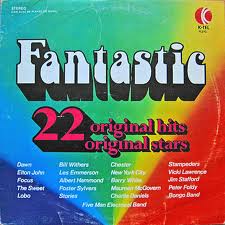
The most recent post on this site discussed the AM rock experience of the late-60s and early-70s. By the early-70s, though, that experience would not have been complete without the frequent appearance of the K-Tel compilation extravaganzas.
The name “K-Tel” was obviously intended to evoke a radio station playing an assortment of “original hits” by the “original artists,” even if some of those “original hits” were severely edited so they could all fit on a single vinyl platter.But at $3.98 for at least 20 songs, you couldn’t really complain about clipped version of some of the tunes. “Radio edits” appeared frequently on 45’s back then, so the practice was hardly novel.
The 1973 release, Fantastic, is the one that most sticks out in my mind. Besides its groovy rainbow cover, the record managed to combine some great moments in pop history with sheer, unabashed garbage. One minute, you’ve got Elton John at the beginning of the peak or his powers doing “Crocodile Rock,” the next minute you’ve got Donny Osmond doing “The Twelfth Of Never.” One minute, you’ve got Bill Withers’ soulful, earnest “Lean On Me,” the next minute you’ve got Focus yodeling their way through “Hocus Pocus.”
The best thing on the disk, however, was “I Wanna Be With You” by The Raspberries. Along with Big Star and Badfinger, The Raspberries comprise the holy triumvirate of early-70s rock bands that influenced all of the Power Pop that came afterward.
“I Wanna Be With You” was not, however, the first song by The Raspberries to grace a K-Tel disk. Their three-minute ode to convincing a certain lady friend to have sex, “Go All The Way,” anchored a prior K-Tel release, Believe In Music. On that one, K-Tel quite nicely displayed its penchant for the yin and the yang and the good and the bad. Believe In Music also included the aforementioned Mr. Osmond doing “Go Away Little Girl” as a kind of counter-perspective to Eric Carmen’s relentless persistence in trying to get his sweetheart to “please, please go all the way.” K-Tel was not about to be accused of bias.
“I Wanna Be With You” is a perfect pop song, with its ringing guitars, pounding beat, simple call-and-response chorus repeated several times and Carmen’s spot-on, expressive vocals. Although treading the same thematic ground as “Go All The Way,” ‘I Wanna Be With You” is a tad less blatant in its declaration of romantic desire. But only a tad:
If we were older we wouldn’t have to be worried tonight
Baby, oh, I wanna be with you so bad
Oh baby I wanna be with you
Oh yeah … well tonight
Tonight we always knew it would feel so right
So come on baby, I just wanna be with you
Perhaps you could say that “I just wanna be with you” is not the same things as “please, please go all the way,” but that might be making a fine line distinction that Carmen probably did not intend. Both are great songs, among the best of the entire decade of the 1970s. Here’s an excellent live performance of “I Wanna Be With You” from 1978:
The Raspberries’ influence on the music discussed on this site was immense, as we shall see in a future post.
My profile on a now-defunct site said that one of my earliest memories of music involved sitting in the backseat of my parents’ avocado green late-60s Chevy Malibu listening endlessly to 93KHJ while stuck in traffic in Los Angeles. The Chevy Malibu, with its black top and black vinyl seats, looked like this:
KHJ ruled the roost in Los Angeles for many years. Its Boss Radio format was copied all over the country:
On May 3, 1965, KHJ was the site chosen for the birth of the new format designed by Bill Drake and Gene Chenault. Ron Jacobs was selected as the first Program Director. BOSS RADIO utilized a tight rotation, top drawer talent, and the elimination of almost all non-essential talk. The Johnny Mann Singers’ jingles didn’t hurt either. Within months, the format spread from coast to coast, and Boss Radio was the king in most markets.
The blogsite 93 KHJ/Boss Radio collects an abundant amount of old Boss Radio material, including images of the station’s weekly Top 30 “Records In Southern California.” These weekly Top 30 lists were available for years “wherever records are sold.” Back then, that included department stores. I remember picking them up at the May Company on Pico Boulevard.
The top songs were, of course, played several times a day. Spending a lot of time in the car, or listening to KHJ at home with the flu, would sear those songs forever into your memory.
It wasn’t just repetition that glued those songs to your mind. It was also the nature of the two-and-a-half minute pop song of the-late 60s and early-70s. They were hooks and melody, hooks and melody, hooks and melody. They were intended to stay in your mind for hours, days and weeks.
Here is the Top 30 from February 22, 1967, as it appears on the Boss Radio site.
“Happy Together” by TheTurtles was No. 1.
“Ruby Tuesday” by The Rolling Stones was No. 3.
“There’s A Kind Of Hush/No Milk Today” by Herman’s Hermits was No. 7 (although “No Milk Today” is the vastly superior track).
“I Had Too Much To Dream (Last Night)” by The Electric Prunes was No. 10.
“Gimme Some Lovin'” by The Spencer Davis Group was No. 17.
“(We Ain’t Got) Nothin’ Yet” by The Blues Magoos was No. 23.
The greatest double-sided single of all-time, “Penny Lane/Strawberry Fields Forever,” debuted on the chart that week at No. 13.
The following week saw the debut on the chart of “Live” by The Merry-Go-Round, one of the greatest pieces of Southern California “sunshine pop” ever put to wax.
Just reading that list, and looking at other late-60s, early-70s lists on the Boss Radio site, will cause an endless number of songs to run through your mind for a very long time.
This all changed by the mid-70s. Melodic rock on the AM dial was replaced by Bloat Rock (Boston, Kansas, Supertramp), Cock Rock (Foreigner) and Plain Old Boring Rock (Bad Company). Kiss and Queen are certifiable geniuses in comparison. Punk and New Wave were cultural imperatives. They just had to happen.
Fast-forward to today. A company called Zikera has created a wonderful application for iOS and Windows 8 devices called “Groove.” Among other things, it sans your devices to create “Groovy Mixes” of songs that work well together based, in part, on data supplied by Last.fm users. It has become my most used “app” since it automatically creates an endless array of playlists.
I was driving to work the other day and a particular “Groovy Mix” played three consecutive songs that, combined, perfectly capture the essence of the melodic rock that comprised the Boss Radio of the late-60s and early-70s.
The aptly named “Pop Sound” by The Masticators came up first. The Masticators were a late-90s Los Angelers-based Power Pop band made up, in part, by Lisa Mychols, about whom I wrote recently. Futureman Records has issued a 33-track compendium of the band’s entire recorded output. Its worth checking out in its entirety for some of the tightest, most head-bopping-est Power Pop around. “Pop Sound” is just that — a joyous, three-chord celebration of rhythm and melody anchored by Mychols’ confident, sexy vocals and a driving, basic beat:
Next up was “Pete Ham” by Crash Into June, a tribute to the late Badfinger singer/songwriter/guitarist. It begins with this bit of resonance: “What’s that song it sounds like heaven/I heard it once when I was seven/You could say it reminds me of summer days/Summer days.” True that, true that. It continues shortly later: “It’s got the 60’s British feeling/Hooks that keep me on the ceiling/I hear it now, its got that pure infectious sound/It keeps my head all spinning around/Spinning around.”
“Pete Ham” is three-and-a-half minutes of pure jangle pop perfection:
The final song in my commuting trilogy was “She Dreams,” from Michael Carpenter’s 1999 debut Baby. “She Dreams” is perfect, joyful “sunshine pop” that gives “Live” a run for its money:
So, there you have it. The old AM rock radio groove hasn’t disappeared in these days of overly processed, mechanical dance pop. You just have to know where to find it. When you do, you will be transported to another place
The Windbreakers were a Mississippi-based band, comprised primarily of Bobby Sutliff and Tim Lee, that released a half-dozen records in the 80s and 90s in the kind of Byrds/Big Star jangle pop/psychedelic amalgam that R.E.M. rode to great success. Although similar success eluded The Windbreakers, Sutliff and Lee are gifted composers and superb guitar players. One of the best examples of their craft is the simply gorgeous, then-new song they recorded as the title track to the band’s 2002 compilation, Time Machine:
Outside of The Windbreakers, Sutliff and Lee have both done about a half-dozen other records each, and have appeared on various compilations and tribute records as performers, songwriters and producers. In June 2012, however, Sutliff was involved in a serious automobile accident near his home in Powell, Ohio. Lee wrote:
At the time, the prognosis was guarded, albeit not particularly promising. But Bobby survived his multiple injuries, and after a month or so of sedation, he slowly began making progress. Eventually, the pace picked up, and his condition continued to improve at an amazing speed. Before long, he was back home and closing in on 100 percent recovery.
But Sutliff’s un-paid medical bills were enormous. Lee thus organized ab bunch of friends to make a tribute record of Sutliff’s songs, an perform a concert in Atlanta, to raise money to defray the expenses. The resulting record, Skrang — a term coined by Sutliff to describe “the sound of an open chord on an electric guitar” — is likely one of the best things you will hear this year. It features performances by long-time purveyors of melodic rock and Power Pop, and not a single bum performance over 18 tracks.
Velvet Crush and Matthew Sweet get the set off to a rollicking start with the ringing “Second Choice.” John Stirrat, best known for his work as Wilco’s bass player, gives “Girl From Washington” a particularly tender feel in front of Lee’s stellar 6 & 12 sting guitar work. Matt Piucci, an original member of Rain Parade who later recorded with Lee in Gone Fishin’, enlists some of his old bandmates for a fuzzy, psychedelic take on “That Stupid Idea.” The Anderson Council play down their more typical Syd Barretisms on “Griffin Bay,” and turn out one of the best, most rocking tracks on the set. Its much more Grip Weeds than “See Emily Play.” Bill Lloyd goes it alone and gives “Same Way Tomorrow,” a slightly updated, smoother take on the Sutliff solo track from 1987. Michael Carpenter, one of my current favorites, lends his typically terrific vocals to “Long Red Bottle Of Wine,” widens the sound and manages to improve on the original:
I could probably write something effusive about each of the 18 tracks on this set. Its just that good. The first-rate quality of Sutliff’s compositions shine through on each of the tracks. Even though some of the performances purposefully veer into territory that is somewhat different than the original version of the songs, the collection has an overall cohesive quality to it that makes listening from start-to-finish a joy. It’s available for $12 from Paisley Pop, and well worth every dime. All proceeds, of course, benefit Sutliff.



 Pop That Goes Crunch!