Sammy Hagar lives in my local community. He is treated heroically in the local press. He’s an entrepreneur, a performer and a philanthropist extraordinaire. He’s supposedly an overall great guy.
That’s pretty odd. To me, Sammy was always associated with particularly bad singing, even worse taste and a very conservative kind of psuedo-rebellion. You probably knew that late-70s/early-80s scene pretty well: guys walking around in long-sleeve concert t-shirts and girls with feathered roach clips in their hair. Cool, dude.
Theolonious Monster was (and still is) an LA-based band that did a kind of Replacements thing in the 80s. They mixed jangly guitars, punk rock, folk rock with drunken sloppiness, punctuating it all with humor.
A “two-fer” CD collection of their second and third albums (Stormy Weather and Next Saturday Afternoon) is consistently great. “Michael Jordan” is a slacker anthem about sitting home all day doing nothing other than watching reruns of The Odd Couple, and then tuning into to watch Michael Jordan score 47 points. “Lena Horne Still Sings Stormy Weather” is about holding onto all of of the good things in life during times of change.
Their greatest song, though, is “Sammy Hagar Weekend.” It captured perfectly a particular type of “Southern California concert t-shirt scene.” There were, of course, versions of that scene everywhere back in the day. The best lines — and you certainly knew some of these people — remain brilliantly on-point:
We got a Metallica t-shirt/We got a little tiny baby mustache/We got a jacked up Camaro/We’re sitting in the parking lot at Anaheim Stadium/Drinking beer, smoking pot, snorting coke/And then drive, drive over 55/Yeah/Cause it’s a Sammy Hagar weekend/It’s a big man’s day
Here is it, in all of its glory:
So, go check out the two-CD set of the band’s second and third long-players — a great and swirling mix of genres, humor and melody. And stick a finger in Sammy’s eye while you’re at it.
The passage of time can give clarity on whether a particular song, or a particular album, that in “real time” influenced your taste in music years or even decades later. For me, that song is “I Will Dare” by The Replacements, the lead track on the classic 1984 release they rather audaciously titled Let It Be.
Before they released Let It Be, The Replacements mostly produced sloppy, loud, fast rag tag stuff. That all changed in the first few minutes of Let It Be, when “I Will Dare” came chiming out of the speakers with its shuffling beat, its mandolin and its twelve-string guitar. The band took the British Invasion and The Byrds, stuck them both in the middle of the punk scene of the mid-80’s, and pointed the way to the future. Its leader, Paul Westerberg, also proved arguably to be the best songwriter of the decade, penning perfect lines like this one that punctuated “I Will Dare”: “How young are you?/How old am I?/Let’s count the rings/Around my eyes.”
But it was the chorus that made “I Will Dare” unforgettable, with its almost tongue-twisting rhythm: “Meet me anyplace or anywhere or anytime/Now, I don’t care/Meet me tonight/If you will dare, I will dare”:
Let It Be ultimately stood between two worlds for The Replacements. Westerberg sensitively tackled confused sexual identity in “Sixteen Blue” and “Androgynous” alongside old-school punk silliness for which the band was known previously in “Tommy Gets His Tonsils Out” and “Gary’s Got A Boner.”
But “I Will Dare” is the standout of the set. Its Big Star-influenced power pop would define the band’s next long-player, Tim, and make it one of the single best records of the 1980s. “I Will Dare” is where punk rock grew up and realized it could write and play beautifully. Almost everything I listen to today, and which is discussed in these pages, reaches back to that time in 1984 when I first heard “I Will Dare.”
Some albums stay with you for a long time. Those are the one you keep coming back to. Sometimes the lyrics speak to you. Sometimes it’s the sound. Sometimes the melodies swirl around in your head for days without prompting.
One such record for me is Seth Swirsky’s 2010 release Watercolor Day. Swirsky worked previously in the music business as a staff songwriter at Chappell Music, Warner-Chappell Music and EMI Music, where he penned songs recorded by Rufus Wainwright, Al Green, and Smokey Robinson, among others. He co-wrote “Tell It To My Heart,” a big hit for Taylor Dayne back in 1987.
As a performer, Swirsky describes his sound as “old school.” It certainly is. Its a magical trip back in time to the pure pop stylings of the 1960s, where an idea, catchy melodies, gorgeous multi-part harmonies, and two-and-a-half minutes of vinyl could yield glorious results.
Although the Beatles are an obvious influence on Swirsky’s solo work, and on the two records released by his band, The Red Button, Watercolor Day feels much more like the Beach Boys’ Pet Sounds. Trumpets, french horns, violas, cellos, oboes and trombones appear seemingly out of nowhere, but nevertheless fit perfectly in the mix and saturate the sound with texture. Swirsky also makes use of the pre-synthesizer Mellotron, an “electro-mechanical, polyphonic tape replay keyboard originally developed and built in Birmingham, England, in the early 1960s.” Or, in other words, a Mellotron uses magnetic tape to coax the sound of virtually any instrument out of a basic keyboard. It was was utilized to great effect on numerous songs in the psychedelic era. Watercolor Day is analog candy for the digital age.
And the candy is attuned to the rhythm of seasons. Much of Watercolor Day evokes the easy, breezy days of summer at the beach. The title song, however, is about a “colder” December day: “It’s a watercolor day/Skies of blue have turned to grey/Her green eyes mix with the sunrise/As the butterflies melt away”:
Summer returns, though, on the next song, “Summer In Her Hair,” which, of course, is all about a girl who’s “got the summer in her long, blond hair.” “4 O’Clock Sun” is a short instrumental with harmonizing voices that feels like a warm late-afternoon at the beach as it starts to fade toward night. Full-circle is achieved by the last song, “Amen,” an ode to the return of autumn, red leaves, bare trees, the rain and an eternal caring hand. The watercolor days of December will soon return.
If all of this sounds like a cloyingly sweet confection devoid of substance, it’s not. The songs are richly detailed soundscapes about, well, life. And Swirsky often gets a phrase down just right. The minor key “Living Room” begins “Empty picture frame, it used to have a photograph/Of her smiling.” We’ve all been there before, in one way or the other. On “She’s Doing Fine,” he sings “she’s doing fine, that’s what her note said/she’s doing fine, she left it on the bed.” More basic truth. His tribute to Harry Nilsson, “(I Never Knew You) Harry” begins “I heard you back in ‘69/’Everybody’s Talkin’ was playing all the time.”
He even attempts a kind of mini-Side 2 of Abbey Road on “I’m Just Sayin,’” a medley of some of the prior songs on Watercolor Day. It also closes with some seriously Beatleseque guitars. “The coda at the end of the album is something that Sir Paul McCartney has done brilliantly over the years and I wanted to attempt it.,” Swirsky says on his website.
And he certainly achieved it. Watercolor Day is one of the best albums of the past decade. It has a handmade, craftsman-like quality that you don’t get very often in these days of processed beats and auto-tuned voices. Not a moment is wasted in the 18 hook-laden songs, some of which clock in at less than two minutes long. Why create clutter? Its far better to get in, get out and leave a lasting footprint on the mind of the listener. That’s exactly what Watercolor Day does.
Most live records are kind of lame. They often lack the immediacy that comes with actually being at the recorded performance. Sometimes the playing is ragged. Sometimes the singing is ragged. Sometimes the recording quality is ragged. Sometimes all of the raggedness of a live recording gets covered up by studio lip gloss, thus defeating entirely the concept of a “live” record. You thus are left essentially with new, likely inferior, studio versions of old songs you probably already have. Why bother?
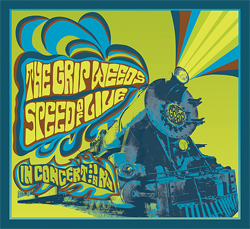
None of that applies to the live released earlier this year by The Grip Weeds called Speed Of Live. The Grip Weeds are a New Jersey band that took their name from John Lennon’s Private Gripweed character in the 1967 film How I Won The War. That, plus a short list of some of the songs they’ve covered in the past, will give you an idea of the musical spectrum from which they hail:
“I Can Hear The Grass Grow” — The Move
“Down To The Wire” — Buffalo Springfield
“She Don’t Care About Time” — The Byrds
Does that mean The Grip Weeds are hopelessly retro and mired in the good old days of the 60s? Not really. They are, first and foremost, a rock and roll band. And they sure can rock. But they are a rock band steeped in the virtues of melody and multi-part harmonies like, well, The Byrds and Buffalo Springfield. And, like those bands, the guitars occasionally jangle and sometimes sound like they came from somewhere in the Middle East.
All of these virtues are evident on Speed Of Live. Immediately after the announcer introduces “this band” as “one of my favorite bands” to start the record, Speed Of Live then proceeds to deliver powerful renditions of thirteen of the band’s best known tracks, and two covers, performed in small clubs in the Northeast. This is hardly a document of cigarette lighter-raised arena rock bloat, replete with endless noodling and solos. It instead shows just how good the band is “in concert.” The singing is sharp. The playing is concise and tight throughout the fifty-seven minutes of bass, guitars and drums.
I can listen to the live version of “Salad Days,” with its occasional “Taxman”-like bassline, over-and-over again. “Infinite Soul,” already one of my favorite songs by the band, has an intimate feel on Speed Of Live as if it was recorded in my living room.
The soaring “Speed Of Life” sounds at least as good live as it does on the band’s last “proper” studio recording, 2010’s Strange Change Machine. “Love’s Lost On You” goes on for six minutes on Speed Of Live, without wasting even one of them. Here’s a shorter version of the song, recorded live in the studio:
The two covers on Speed Of Live? “(So You Want To Be A) Rock ‘n’ Roll Star” by, of course, The Byrds. This version seriously rocks, with absolutely perfect harmonies, spectacular guitar playing and lots of “la la la’s.” They also do one of the best versions of “Shakin’ All Over,” which has been recorded dozens of times, most famously by the Guess Who and The Who.
Speed Of Live is not a live record that is just “not lame.” Its fifty-seven minutes go by in what seems like an instant. There is not a single weak song in the collection, or a dull interlude in any of the fifteen songs. The record sounds great whether you are listening with headphones, or driving around in traffic at the end of a tough day at the office. In other words, Speed Of Live is just great rock and roll by a band that deserves a whole lot more attention than it receives. Go out and get it.
[This appeared originally in the now-defunct MT Weekly]
This is the third installment of a series. Due to the subjective nature of what quantifies a One Hit Wonder, how much of the band must be dead to be a One Hit Wonder With Dead Guys, etc., etc., etc., there will be some shifting of the goal posts across these essays. Such is life and rock ‘n roll.
Goal Post Shift 1: Big Star never got anywhere near a hit. Big Star’s singer/guitarist Alex Chilton did have a #1 – “The Letter” – with his previous band, The Box Tops, for four weeks in the summer of 1967, when he was sixteen (with a much older voice). But the closest Big Star got to the charts during their existence from 1971 – 1974 was nowhere, and the closest they got to public acclaim was in 1998, when the song “In the Street” was appropriated as the theme song of…
Yes, I know, cover versions of songs can suck eggs. Sometimes they are slavish imitations of the originals, hoping to cash in on familiarity. Sometimes they try so hard to be wildly different than the original that they succeed only in being wildly different than the original. No matter what, though, the original usually is better than the cover.
The song “I’m Shakin'” has been around the block a couple of times.
Little Willie John, whose 1956 waxing of “Fever” went to the top of the R&B charts, did the first version of the song, way back in 1961.
The Blasters never failed to get the crowd moving with their jazzier version, first recorded in 1981. I remember almost being knocked over a couple of times when they played it at one of their shows.
The new edition of the song by John Anthony Gillis, known better as Jack White — formerly of the White Stripes, the Raconteurs and many other bands and one-offs — is a rollicking, no-holds-barred workout with a couple of slicing guitars, some hand claps and female back-up singers added to the mix.
The AllMusic guide White’s version of “I’m Shakin'” “clumsy” and “cabaret.” If it is “clumsy,” its perfectly “clumsy,” consistent with White’s analog, tape and razor blade approach to record-making. He makes “I’m Shakin'” entirely his own. It is indeed a record, in the best mid-70s meaning of the word. It’s over-the-top in a good way.
So, here it is. I dare you to remain still while listening. The thing just moves. And enjoy the wacky home-made video mash-up featuring the Soul Train dancers:
The last post on this blog displayed a decided preference for the easy, the breezy and the casual in rock music over the making of Big Statements. Rock musicians just ain’t philosophers.
That got me thinking about the most simple, catchy two-chord pop punk issued over the last year. And it was put out by a guy — along with his family — with a natural penchant for navel-gazing and the issuance of important proclamations about life.
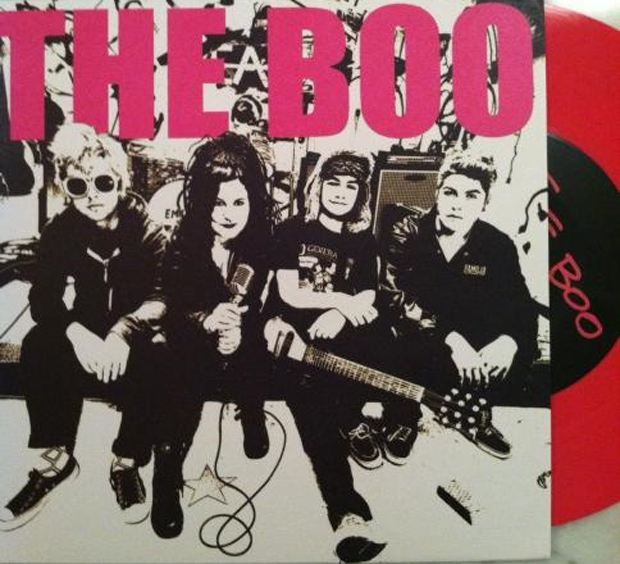
That would be “I Want Revenge” by The Boo, a side-project of the occasionally self-important Billie Joe Armstrong. While Green Day certainly has put out a lot of catchy two minute pieces of pop punk goodness, it occasionally shows bloat rock tendencies. However, the band’s earlier side project, The Foxboro Hot Tubs, put out a terrific — and quite fun — record a couple of years ago steeped in the British Invasion and Garage Rock. It made no Big Statements.
The Boo, though, is even more simple, consisting of Armstrong, his wife and their two sons. It sounds positively 1979. Its fast. Its kind of repetitive. Its kind of obnoxious. It conveys a single theme over three buzz-saw minutes — “you broke my heart, I’m gonna get you back.” It thus has all of the elements to have been featured prominently on Rodney on the Roq way back in the day. Here it is:
Heck, the packaging even looks like a 45 sold at Rhino Records back in 1979:
Channeling 1979
You can call “I Want Revenge” nostalgia. You can call it backward-looking. Or you can just call it fun. It makes no Big Statements. It doesn’t even try. And that’s a really good thing.
I just checked the Billboard Top 200. The top-selling long player? The latest by Usher. No. 2? The latest by Rush. Really? Who wants to hear a bunch of old prog rockers with high voices and phony libertarian politics? Here’s how the AllMusic guide describes that one, which is a “concept” album:
It centers on a loose narrative about a young man following his dreams. He struggles with inner and outer forces of order and chaos; he encounters an expansive world where colors, images, territories, and characters are embodied by pirates, strange carnivals, rabble-rousing anarchists, and lost cities. His enemy is the Watchmaker, a ruthless authoritarian presence who attempts to rule the universe and all aspects of everyday life with fascistic precision.
Yep, unicorn rock. Come sail away, lads.
But in the meantime, I recently downloaded some long players from Rhapsody for a couple of coast-to-coast flights. They feature real electric guitars, real acoustic guitars, real pianos, real cymbal crashes, an occasional mandolin, finely crafted melodies, and occasionally perfect harmonies.
One of them was “Down By The Old Mainstream” by Golden Smog, a supposed alt-country supergroup. Yes, they plowed some country fields. But this long player from 1995 is chock full of pure pop hooks and wistful melodies via Wilco’s Jeff Tweedy and Gary Louris of the Jayhawks. It was so far out of the mainstream in 1995 that it didn’t even make the Billboard Hot 200 album chart. Seventeen years later, its downright obscure.
But it shouldn’t be. It starts with a bit of pure melodic brilliance powered by piano hooks, a paean to a long-gone girl simply named “V.” Its worth a listen — or many listens — even if you have to watch a silly cell phone commercial first:
Two songs later you get “Pecan Pie,” Jeff Tweedy’s decidedly un-serious folky, extended metaphor for the girl of his dreams: “And a piece of pecan pie. And you that’s all I want. Just a piece of pecan pie. And all I want is you.” Then he sings about the whipped cream.
And that’s the other big joy of this long player. Its loose. Its ragtag. It never takes itself seriously. Its not about pirates, ruthless authoritarians and fascistic precision. Its just, well, fun. What else can you say about a collection with a song called “He’s A Dick,” about a guy that borrowed some cash from you years ago, did not pay it back and then looks away whenever he sees you? That happens in real life. But its not weighty enough stuff for those intellectuals in Rush and their Number 2 record in the nation.
But back to this music. Also check out “Friend,” which shifts nicely between casual mid-tempo mellowness and pounding power pop. “Down By The Old Mainstream” does that simply because it can. Its all over the place. By design.
I made up a category of music: Blatantly Psychedelic Songs.
Sometimes its the sound. Sometimes its the title. Sometimes its both. Most of the songs hail from the late-1960s, of course. The songs are not only “psychedelic,” but they are “blatantly” so.
Some of the finest examples of this entirely made up genre include:
“See Emily Play” — Pink Floyd
“Incense and Peppermints” — Strawberry Alarm Clock
“Pictures of Matchstick Man” — Status Quo
“Paper Sun” — Traffic
And, of course, “Strawberry Fields Forever” — The Beatles
A particularly cool exemplar, however, is “I Can Hear The Grass Grow” by The Move. Hearing the grass grow? Now that’s blatantly psychedelic.
The Move, unfortunately, did not achieve success in the U.S. as “The Move,” although they were all the rage in the U.K. in the late-60s. They did achieve success in the U.S. when they later morphed into “ELO,” but that’s another story.
Back to listening the growing grass. Here’s some choice verbiage:
My head’s attracted to/Magnetic wave of sound/With streams of coloured circles/Makin’ their way around
I can hear the grass grow/I can hear the grass grow/I see rainbows in the evening
Not the stuff of normal consciousness.
But there’s also the sound:
That’s not only “psychedelic” in a 1960’s sense, but it sounds a lot like “modern rock” or “alternative rock.”
Ahead of its times? Yes, and quite influential on what came next.
“I Can Hear The Grass Grow” and two dozen other choice cuts can be found on an import remastered “Very Best Of” disk:
The MC5 were known for their loud, brash punk rock a decade before punk rock supposedly existed. Their debut album, “Kick Out The Jams” (1969), was recorded live and presented a sonic onslaught of guitars, bass, drums, uncompromising revolutionary politics, sex and drugs. All par for the course in 1969.
Their rallying cry, “Kick out the jams, motherf*ckers” caused the album to be banned by a number of different retailers, propelling it naturally to the Top 30. It even hit Number 45 on the R&B chart.
“Kick Out The Jams” was, in no way, a melodic pop album:
Things changed a year later. Jon Landau, who later worked with Bruce Springsteen, produced “Back In The USA” and imparted a clean, compact sound that was radically different than what it succeeded. And did it ever succeed.
Its best song, “Shakin’ Street,” managed to be power pop before power pop supposedly existed. It managed to be new wave before new wave existed. Its strummed and chiming guitars will cause you to shake and to move. The song itself sounds like it was moving to wherever “Shakin’ Street” is located.
And, its got great characters. Besides Little Orphan Annie and “Sweet Sue too,” there is Streetlight Sammy coming “all the way from New Jersey on his girlfriend’s tips.” He came to meet “skinny leg Pete.” And then there is Sally Baker who “wants to shake her shaker.” They all came to a world-wide party on “Shakin’ street, where all the kids meet”:
“Shakin’ Street” is another song that was years ahead of its time. As I wrote previously, that is a testament both to its influence on everything that came after, and to its overall greatness.





 Pop That Goes Crunch!